
Search engines evolve constantly, but one truth remains unchanged: SEO success depends on clean code, fast loading speed, strong structure, and optimized content delivery. As AI-powered web development explodes in popularity, many businesses are asking the same question:
Can AI HTML builders really outperform manual coding in SEO rankings?
This article breaks down the strengths and weaknesses of both approaches, supported by insights, examples, and real-world observations. Whether you are a developer, agency owner, or business looking to improve your website’s visibility, you’ll learn how each method impacts SEO—and which option delivers the best long-term results.
1. Introduction
Search engine visibility has become the strongest competitive edge for any business operating online. When a website loads fast, displays well across devices, and maintains clear structure, Google rewards it with higher rankings. Conversely, bloated code, accessibility issues, and poor structure can suppress even the best content.
As AI reshapes the web development landscape, AI HTML builders—tools that automatically generate HTML code using artificial intelligence—are becoming extremely popular. They promise quick development, automated layouts, instant responsiveness, and time savings.
On the other side is manual HTML coding, the traditional method where developers handcraft markup, CSS, and component structures for maximum precision, customization, and SEO control.
This article explores how each approach influences SEO performance, which method aligns better with Google’s ranking systems, and how businesses can make the right choice depending on their needs.
2. Understanding SEO
To understand how AI HTML builders and manual coding differ, we must begin with the fundamentals.
What Does SEO Really Depend On?
While SEO includes content, keywords, backlinks, and user behavior, technical SEO is where HTML structure plays a critical role. Google evaluates:
1. Website Speed
- Clean code = fast loading
- Heavy scripts = slower page speed
- Faster sites consistently rank higher
2. Mobile Responsiveness
- Proper HTML semantics make mobile optimization easier
- AI tools may generate unnecessary code, harming responsiveness
3. Core Web Vitals
Google’s ranking signals include:
- Largest Contentful Paint (LCP)
- First Input Delay (FID)
- Cumulative Layout Shift (CLS)
Manual coding allows developers to fine-tune these metrics more effectively.
4. Proper HTML Structure
Elements like:
<header><nav><main><article><section><h1>–<h6>hierarchy
These structures help Google understand your content.
5. Schema Markup
Structured data dramatically enhances visibility and click-through rate (CTR).
Manual coding enables full customization, while AI builders may limit schema flexibility.
6. Code Bloat
The cleaner your code, the easier it is for Google to crawl your website.
AI tools sometimes generate unnecessary lines of HTML, inline styles, or repetitive elements. This can slow down crawling, indexing, and negatively impact rankings.
3. Overview of AI HTML Builders
AI HTML builders automate website creation using generative models trained on thousands of website patterns. Users simply describe what they want—colors, layout style, UI structure—and the AI instantly generates ready-to-use HTML, CSS, and sometimes JS.
How AI HTML Builders Work
- They parse your instructions (text or wireframe).
- They generate HTML structure automatically.
- They apply CSS or frameworks like Tailwind/Bulma.
- Some tools offer auto-SEO recommendations.
- They output a complete, ready-to-launch webpage.
Benefits of AI HTML Builders
✔ Faster Development – Pages can be generated in seconds.
✔ Low Cost – Useful for startups or small projects.
✔ Beginner Friendly – No coding expertise required.
✔ Decent Visual Output – AI can design good layout structures.
✔ Rapid Prototyping – Perfect for MVPs or exploratory designs.
Popular AI HTML Builder Tools
These tools prioritize speed and accessibility. But speed of creation doesn’t always equal speed in SEO performance.
Limitations of AI HTML Builders
❌ Code Bloat
AI-generated HTML sometimes contains redundant elements, inline styling, unused classes, and unnecessary wrappers.
❌ Limited SEO Control
Structured data, custom meta rules, advanced indexing controls, and sitemap organization may not be as flexible.
❌ Generic Semantics
AI tends to follow patterns, not strategy—leading to suboptimal HTML hierarchy.
❌ Dependence on Platform
Users are often restricted by the builder’s constraints or subscription model.
4. The Manual Coding Approach
Manual coding refers to writing HTML, CSS, and JavaScript by hand. It is traditional, reliable, and still the gold standard for high-performance websites.
Why Manual Coding Still Dominates High-Level SEO
1. Total Control
Developers can optimize:
- semantic structure
- heading hierarchy
- CSS delivery
- image loading behavior
- JavaScript execution timing
This level of control cannot be matched by automated tools.
2. Cleaner, Leaner Code
Manual code is:
- precise
- minimal
- free from useless wrappers
- easier for Google to crawl
Cleaner code = faster ranking improvements.
3. Accessibility Compliance
Manual coding ensures proper:
- ARIA attributes
- alt tags
- form labeling
- navigation structure
These are essential for SEO and user experience.
4. Performance Optimization
Developers can control:
- compression
- lazy loading
- minification
- CDN logic
- external scripts
AI cannot replicate these decisions effectively.
5. Full Customization for Branding
Manual coding gives unique identity and avoids “template-like” designs.
Challenges
- Requires advanced skill
- Takes more time
- Higher initial cost
But the long-term ROI is significantly stronger, especially for businesses relying on SEO.
5. Comparative Analysis: AI vs Manual Coding
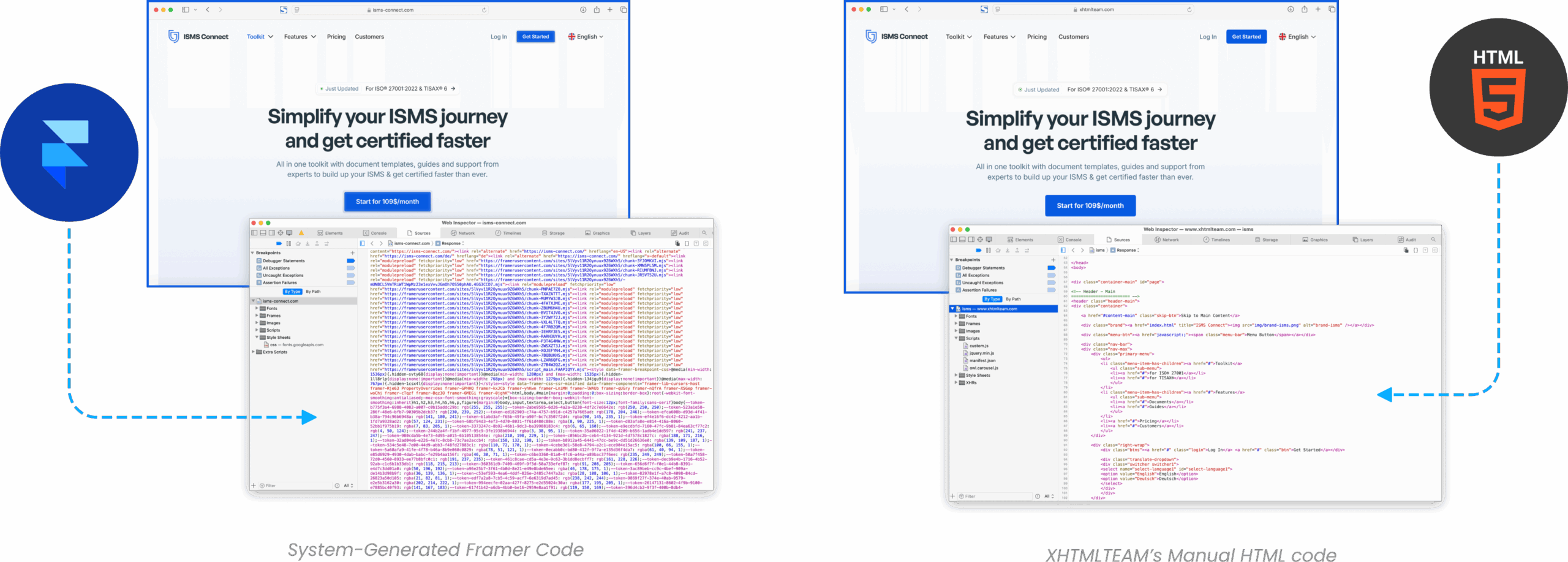
Framer’s Auto Generated AI code vs XHTMLTEAM’s Manual HTML code.
This section evaluates both approaches across major SEO and business factors.
A. SEO Effectiveness
AI HTML Builders
- Can produce responsive layouts automatically
- Often generate excessive or repetitive code
- May mishandle heading hierarchy
- Limited on advanced schema markup
- Inline CSS and heavy JS reduce performance
- Great for fast setups but not deep optimization
Manual Coding
- Clean HTML and CSS ideal for fast loading
- Perfect semantic structure encourages indexing
- Developers can reduce CSS/JS payload dramatically
- Full control of meta, schema, and canonical tags
- Consistently better Core Web Vitals
Verdict:
Manual coding wins decisively.
Search engines prefer clean code—and humans write cleaner code than machines.
B. Time Efficiency
AI HTML Builder
-
Generates pages instantly
-
Great for prototypes and small sites
Manual Coding
-
Takes significantly longer
-
Requires coding expertise
Verdict:
AI is faster, but speed of development ≠ speed of website performance.
C. Flexibility & Customization
AI HTML Builder
- Limited to platform capabilities
- Output often generic
- Difficult to create deeply custom features
Manual Coding
- Unlimited customization
- Tailored to business goals, brand identity, and SEO strategy
Verdict:
Manual code offers 10× more flexibility.
E. Learning Curve
AI HTML Builder
- Beginner-friendly
- No coding required
Manual Coding
- Requires knowledge of HTML, CSS, JS
- Requires SEO and performance expertise
Verdict:
AI wins on accessibility, but not on professional quality.
Case Example
A business using AI-generated pages may experience:
- slower loading
- duplicated markup
- weaker mobile performance
- missing meta structure
Meanwhile, a manually developed site with optimized code often:
- loads in <1 second
- ranks higher for competitive keywords
- retains users longer
- converts more traffic
This difference is often the deciding factor in real-world SEO campaigns.
6. SEO Best Practices for Both Approaches
Whether using AI or manual coding, certain SEO fundamentals remain essential.
1. Mobile-Friendly Structure
Google prioritizes mobile-first indexing.
2. Optimized Images
Use:
- WebP
- Lazy loading
- Proper dimensions
3. Clean Heading Hierarchy
Each page must contain:
- one <h1>
- meaningful <h2>–<h6>
4. Compressed CSS & JS
Reduce render-blocking resources.
5. Structured Data (Schema)
Helps Google understand your content better.
6. Meta Tags
Requires:
- optimized title
- compelling meta description
- canonical URL
7. Fast Hosting + CDN
Essential for stability and global performance.
8. Semantic HTML
Helps search engines interpret your content clearly.
7. Expert Opinions
SEO professionals consistently agree on one thing:
“Clean, lightweight, well-structured code ranks better than automated code.”
Developers also add:
“AI tools are great for prototypes, but for production-grade SEO, manual coding remains superior.”
Industry Trend
AI will continue improving, but manual coding is not going away. Instead, developers are using AI as a helper—not a replacement.
The trend is hybrid development, where developers refine AI-generated code manually.
8. Why XHTMLTEAM Is the Best Choice for Manual-Coded Websites
Many businesses struggle to achieve high rankings simply because their website code is bloated, outdated, or incorrectly structured. XHTMLTEAM specializes in handcrafted, SEO-optimized HTML that outperforms AI-generated code in every measurable metric.
Why Choose XHTMLTEAM?
✔ Pixel-Perfect Manual Coding
Every element is built from scratch with precision—no auto-generated clutter.
✔ SEO-Engineered Structure
HTML is optimized for:
- fast crawling
- proper semantics
- Core Web Vitals
- accessibility standards
✔ Lightweight and Fast
Manual code ensures your website loads quickly, improving:
- ranking
- user experience
- conversion rates
✔ Proven Expertise (15+ Years)
XHTMLTEAM developers understand:
- clean code
- responsive design
- mobile optimization
- schema markup
- SEO architecture
✔ Better Than AI Builders
Unlike AI, XHTMLTEAM:
- writes intentional, not generic, code
- eliminates code bloat
- creates unique branding and design
- optimizes every pixel for rankings
If your business depends on SEO, manual-coded websites by XHTMLTEAM provide long-term value and measurable results.
Convert Your Design to HTML Website Now!
Boost Your SEO with Clean, Hand-Coded HTML. Get a Free Estimation.
9. Conclusion
The question is no longer whether AI can build websites—it can. The real question is:
Do AI-built websites perform better in SEO than manual-coded websites?
After evaluating performance, code quality, customization, and ranking factors, the answer is clear:
AI HTML Builders
Great for speed, prototypes, and beginners—but limited in SEO precision.
Manual Coding
Superior in structure, performance, customization, and long-term rankings.
For businesses aiming to dominate search results, manual coding—especially by experts like XHTMLTEAM—delivers unmatched SEO performance. As AI evolves, it will enhance workflows, but manual craftsmanship in coding remains essential for ranking, speed, and long-term digital success.